
Yellowstone Caldera
Yellowstone Hotspot and Volcanic Activity
Yellowstone's geothermal phenomena, such as the geysers and hot springs, are driven by an unusually strong heat flow. This, in turn, is probably generated by a stationary hotspot over which the North American plate drifts from northeast to southwest:
|
|
|
Click image for larger version.
|
| Apparent migration of Yellowstone hotspot: Ancient caldera locations are indicated by coloured patches. From left to right: 16.5-15 million years ago (palest blue), 15-13, 12-10.5, 10.5-8.6, 10-7, 6.5-4.3 (darkest blue), 2.1 (brown, partially hidden), 1.3 (red) and 0.63 million years ago (pale orange). In fact the hotspot is supposed to be stationary below the North American plate which drifts towards southwest (bottom left). Small orange dots are earthquakes registered from 1961 to 2001. Picture generated using Jules Map Server. |
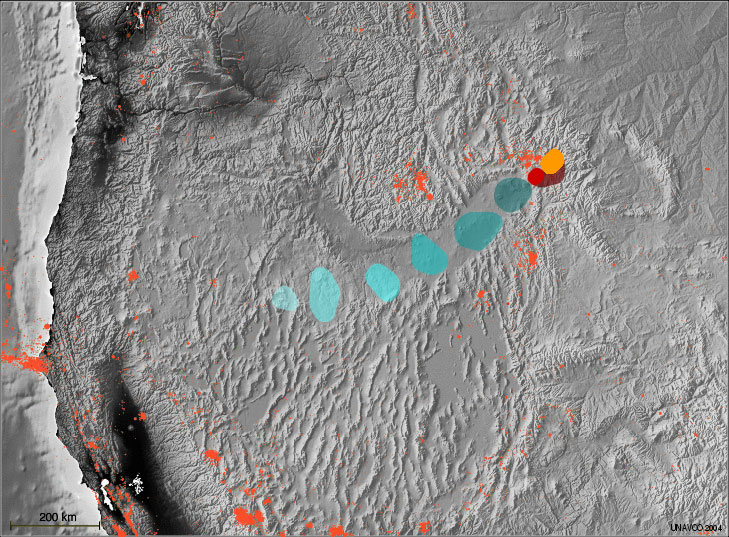
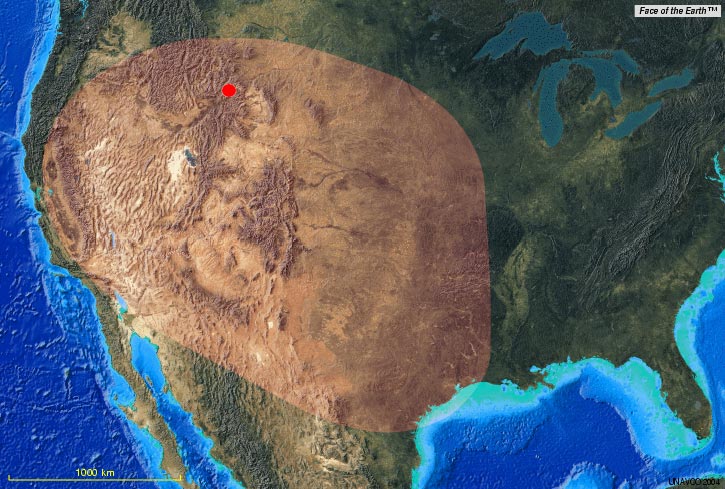
Remarkably, the migrating hotspot leaves a path of relatively flat terrain, the Snake River plain within the otherwise rather rugged topography. In addition, all hotspot locations older than 2 million years are seismically quiet. In contrast a parabola shaped zone of high earthquake activity surrounds the path. The volcanic eruptions after which the calderas were formed, were of truly gigantic proportions: The last one of these, 630'000 years ago, produced 1000 cubic kilometers of ash which got spread over almost the entire western United States:
|
|
|
Click image for larger version.
|
| Approximate extent of ash deposits from Yellowstone's giant eruption 630'000 years ago. Picture generated using Jules Map Server. |
The previous caldera forming eruption of 1.3 million years before present produced 280, the one of 2.1 million years a staggering 2450 cubic kilometers of ash. These and the Toba caldera of Sumatra are among the greatest quartenary volcanic eruptions known worldwide. In comparison, the 1980 eruption of Mount St. Helens seems minute: only 1.3 cubic kilometers of lava was erupted. The most recent volcanic eruptions took place at Yellowstone 70'000 years ago. For more detailed information go to "Volcanic History of the Yellowstone Plateau Volcanic Field" by the USGS and University of Utah.